As modern roasting becomes increasingly data-driven, software is giving roasters newfound freedom to experiment with profiles before a single bean hits the drum.
Few processes in coffee are as delicate – or as decisive – as roasting. Every batch is a dance between heat, airflow, time, and human intuition – and for many roasters, there’s an ever-present challenge to experiment with profiles to unlock a bean’s full potential.
It can take multiple, subtle adjustments for roasters to nail the desired profile. In turn, roasters would run a batch, save the results, taste the outcome, and make incremental adjustments before trying again. Eventually they would be satisfied.
But as roasting operations have scaled and expectations grown around quality and efficiency, the need for a more predictive, less wasteful way to design profiles became clear.
Software platforms like Loring Smart Roast’s Roast Architect are set to transform this process by allowing roasters to model, adjust, and analyse profiles before loading a single bean into the machine.
The technology first launched in 2018 in beta format to obtain feedback on how the program helps roasters with profile development and management. After taking this on board, the United States-based company announced its commercial release on 8 December 2025.
One of the first major showings will be at the Melbourne International Coffee Expo (MICE) in late March 2026.
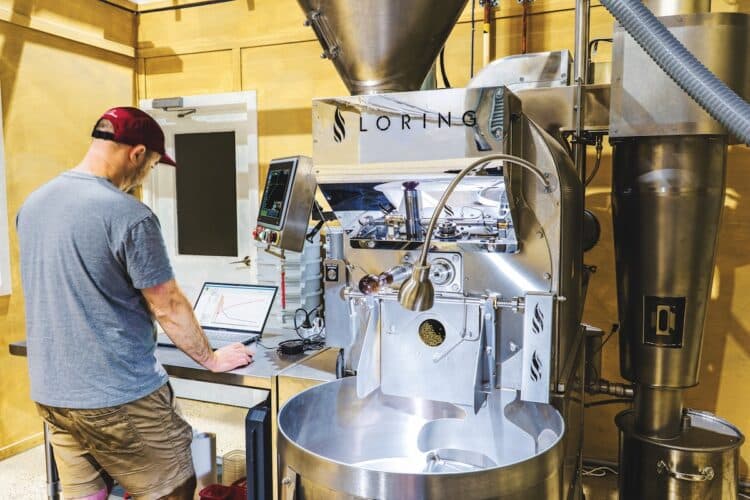
Speaking to Global Coffee Report, Loring President Bob Austin says the company’s reputation has been built on state-of-the-art roasting technology, now producing four machines of varying size and capacity (1.4-70kg) – all with the same single burner convection design Loring is famous for.
Other unique selling points of Loring roasters include up to 80 per cent fuel-savings and reductions of greenhouse gases compared to conventional roasters. Plus, designs that automate several physical tasks, like lifting beans to the hopper – an attribute that can free up more time for high-level activities, whether that be cupping or customer service. Or more energy to develop new roast profiles.
Discussing the genesis of Roast Architect available on a Windows-based application (app), Austin says Loring saw demand for a solution that would let roasters design profiles on a PC prior to running roasts. In turn, they would avoid the need to run a roast batch and file that profile away for future use.
“Roast Architect allows users to take control of their roasting process with a powerful application built exclusively for Loring roasters. It allows them to design their roasts with confidence, reduce waste, and achieve consistent results every time,” he says.
“It eliminates the guesswork, offering more precision, efficiency, and control.”
It also enables roasters to modify ‘known profiles’ on their PC ahead of running the next roast based on the results of previous roasts.”
Before profile roasting – and the ability to design roasts in advance – Austin says the only alternative was to run a roast and save the profile.
“And modification of this profile was also more difficult as there was not a tool to show the effect on rate-of-rise (RoR) in advance,” he says.
“Roast Architect gives roasters the ability to perform ‘what-if’ analysis in advance and not have to use or waste beans to be able to achieve the desired results.”
For Loring customers seeking to integrate Roast Architect into their workflows, it requires a Windows 10/11 PC to install and run the program. The PC loaded with the software then connects to the user interface on the Loring roaster. This connection allows the roaster to view, modify, and save profiles on the PC, then upload to the roaster. Roast Architect can also support the connection to multiple roasters.
Performing that ‘what-if’ analysis enables users to reach a more precise starting point before running a roast, which would traditionally involve feedback from cupping and later modifying for better results.
“Pre-design of profiles limits wasted coffee, as well as giving the user a profile management system,” Austin says.
Loring Roastmaster, Specialty Coffee Association Authorised Trainer, and roasting consultant Michael de Renouard got to test a pre-release version.
“Roast Architect is the best tool for automatic roasting and it just got better. Knowing the Loring roaster performance parameters for a chosen batch size and adjusting the profile design to the nature of the PID controller, the roast execution will always be very consistent,” he says.
Rob Hoos, a fellow Loring Roastmaster, consultant, and author of popular roasting theory book Modulating the Flavor Profile of Coffee adds: “Roast Architect is what roasters who utilise the Loring’s automation need to effectively design and manage their profiles.”
Painless migration
Delving more into the profile design process, Austin says Loring’s Roast Architect means roastmasters can edit profiles through a combination of enterable attributes and a point-and-click curve editor.
They can also specify end of roast (EoR), charge temperature, plus more, down to the second.
When ready, profiles can be uploaded directly to any Loring roaster on the network. The program also allows direct access and editing of files on the roaster.
“Roast Architect allows you to edit and manage files on your roaster from your computer via LAN connectivity, or save works in progress on your PC,” Austin says.
“When ready, users can upload their profile from Roast Architect directly to a roaster. Their masterpiece is ready to roast, and they can also create an archive of all profiles on their roaster, so that there’s always a backup at hand.”
For roasters integrating the software, Loring has prioritised “effortless conversion” from their previous roasting profiling platform.
Roasters can open and convert profiles from older versions and formats, making it “painless to migrate” to the new program.
“It means our customers can upgrade to the latest and greatest, and bring their best-selling profiles,” Austin says.
Scott Burchell, Director of Sales and Marketing at Loring, adds: “This release of Roast Architect streamlines the process of designing roast profiles and sharing them between different machines and systems. Plus, the program is compatible with the profiles and recipes they’re already using, so they won’t need to redo any of that work and can just jump right in with the new program.”
For Loring, it’s all part of a service that stretches beyond high quality, US-designed and manufactured roasting hardware.
“Loring continues to advance the state-of-the-art in roasting technology with continued improvements in both the operation of the roasters, and with supporting software tools like Roast Architect,” says Austin.
“We’re looking forward to introducing the fully supported, production version of this software.”
Roast Architect will be available with a one-time perpetual license fee of US$399 or as a subscription with a 14-day free trial, then US$9/ month or US$99/ year.
For more information, visit loring.com.