As global roasting operations face pressure to cut emissions and future-proof their plants, one of Italy’s best-known coffee processing equipment manufacturers is betting big on electrification.
There are few industries untouched by electrification – a movement that’s transforming how factories, plants, and production lines operate. From automotive assembly to food processing, businesses are replacing fossil fuel-based heat and power systems with electric alternatives to improve efficiency, reduce emissions, and take advantage of renewable energy.
Coffee roasting is now following suit. Leading coffee processing equipment manufacturers, such as Italy’s Brambati S.p.A., are launching their first generation of fully electric roasters alongside gas combustion models, to use cleaner, easier-to-manage energy sources. All without sacrificing operational throughput or cup quality.
Brambati says the transition is already under way, with its customers seeking alternatives to nitrogen oxide and carbon emissions inherent to gas burners.
The company’s electric platform eliminates those fossil fuel-related outputs, offering roasters a pathway to decarbonise their operations while taking advantage of renewable electricity where available.
Electrification could well prove an inflection point in the company’s rich 80-year history. It’s an evolution of a journey that’s prioritised roaster energy efficiency through features like heat recovery systems, smart controls, eco-friendly afterburners, and catalytic converters.
A top priority among roasters right now, according to President Fabrizio Brambati, is investing in solutions that pair high performance with environmental sustainability.
He believes Brambati has risen to the challenge with its new generation of electric roasters – designed to handle batches from 100 grams up to 60 kilograms of green coffee – with models that might process 120 kilograms and above underway.
In short, it means Brambati’s new electric designs can scale for different needs, from small specialty roasters to industrial plants.
“The ideal customers are those who have self-generated electrical power like solar panels or wind turbines,” says Brambati, a third-generation owner who runs the company alongside his cousin and Vice President, Andrea.
“Second to that are countries where the electrical energy is costing less than fossil-based fuels. And thirdly, countries where governments are incentivising the transition towards more sustainable and green economies.
“The only limitation is the availability of higher electrical capacity.”
Consistent and reliable
With the electrification of technology across industries, attention turns to performance. Is the electrical version comparable to traditional methods?
Brambati says the company’s electric roasters are capable of meeting the same performance as gas-based models.
“There are no differences in consistency and reliability,” he says. “Electrical roasters can be designed to have the same production capacity of gas-based ones, but for now we are choosing to deliver electrical roasters with slightly less production capacity to avoid heavy electrical power demands.”
During roasting, operators who switch to electric can expect meaningful energy savings, especially in while in standby mode.
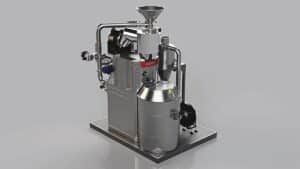
Breaking down the technology, Brambati says the electric version of its roasters features a fully electrical heat generator, heated by electrical resistances, instead of mixing ambient and recycled roasting air with combustion gases derived from the oxidation of fossil-based fuels, such as natural gas.
In other words, instead of burning gas to make heat, the electric model uses electricity to make heat directly, with no combustion involved. That means there is no production of carbon dioxide, carbon monoxide, or nitrogen oxide generated by the combustion of fossil-based fuels, resulting in a smaller greenhouse gas and carbon footprint.
Brambati says it’s important to note that its electric roasters do not eliminate greenhouse gases entirely from the coffee roasting process.
“The reason is that many pollutants are due to chemical reactions happening in the roasting process itself, which cannot be eliminated by the use of heating electrical equipment,” he says.
“Instead, electrical heaters are reducing roaster emissions, but this is in terms of the emissions generated by the oxidation of fossil fuels – not the emissions generated by coffee roasting.”
For roastmasters that eventually adopt this technology, Brambati expects them to adapt immediately.
“The human-machine interface and roasting recipes remain the same. The only difference is that the burners will be powered by electricity, rather than gas, but this is indistinguishable for the roastmasters,” he says.
“As customers move to electrical roasting equipment, Brambati will continue to support our customers in any possible way – whether it be through remote assistance, or the presence of our personnel in any part of the world.”
Beyond the environmental benefits, Brambati adds that the shift to electric introduces practical safety and building advantages for roasting operations.
With electric heaters, roasters avoid the extensive safety mechanisms required for gas systems – from gas detection sensors to ventilation protocols and emergency shut-off devices.
“With electric heaters, you don’t need the safety equipment required for gas systems, because you’re not dealing with a potentially dangerous fuel,” Brambati explains.
“This removes a layer of complexity and cost for our customers.”
As the global coffee industry contends with rising energy prices, stricter emissions regulations, and growing pressure to operate more sustainably, Brambati believes electrification will continue to play a defining role in how roasteries are built and run.
“Across every manufacturing sector, electrification is becoming the common language of progress,” Brambati says.
“Coffee is no different. If we want to create roasting plants that are efficient, resilient, and ready for the coming decades, we must invest in technologies that reduce environmental impact without compromising performance. Our commitment to electric roasting is part of that vision – giving customers a cleaner, smarter, and future-proof way to roast.”
For more information, visit brambati.it