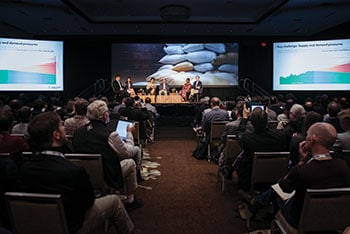
In the opening address of the 10th Re:co Symposium in Seattle, United States, Peter Guiliano, Chief Research Office for the Specialty Coffee Association (SCA) welcomed hundreds of industry attendees and asked one thing: “What can you do over the next 10 years to make a positive impact to the coffee community?” The two-day event at Seattle’s Westin Hotel was designed to challenge the audience and inspire them with new information through high-level discussion on leading innovation and strategy development. Sustainable Harvest Founder David Griswold, former Director of World Coffee Research and World Coffee Events Ric Rhinehart, and illycaffé Chairman Andrea Illy, kicked off proceedings with a discussion on the state and future of the coffee economy. Illy talked about the trends in coffee’s economy, including differentiation, sustainability, globalisation, climate change, and consolidation. He spoke about agriculture commodity deflation, physical versus stock market decoupling, the growth of global retail sales in volume of roast and ground coffee, vertical integration of direct sourcing, and emerging coffee markets with Asia Pacific leading the pack at 7 per cent, followed by Middle Eastern Africa at 4 per cent, Latin America at 3 per cent, and Eastern Europe and North America at 1 per cent. Illy pointed to the fact that coffee had reached one of its lowest price points at 112.56 US cents per pound. “We’re on the horizon of an Arabica crisis,” he said. “If demand continues as it is today, with a 2 per cent annual increase, we will need 300 million bags by 2050. That’s double our current production, and without considering the impact of climate change. It’s no longer a risk. It’s a reality. So when Brazil’s production is wiped out, what then? We’ll need to scale up our annual investment in sustainability from US$350 million to US$1 billion in the next few years if we want to secure the future of our production.” Rhinehart spoke about the microeconomics of coffee and the current growth rate of washed Arabicas, which could represent just 21 per cent of the world’s production volume by 2030. A panel discussion suggested that farmers can’t continue to produce coffee with their current income levels. Phyllis Johnson, President of BD Imports, referenced a 2017 Financial Times report, which stated that the price of a cup of coffee in cafés in London and New York was US$3 to US$4, but the sum received by the farmers was just US$0.05. “We need to create a new value for this thing called coffee. How much do we need to consume in order for farmers to receive more?” Johnson said.
Kim Elena Ionescu, Chief Sustainability Officer for the Specialty Coffee Association, led the talk on sustainability, with input from Andrea de Freitas, Executive Director of the Sustainable Agriculture Network, and Vava Angwenyi, Founder of Vava Coffee. Ionescu said that while, on average, sustainable efforts in the workplace had improved from 10 years ago, there’s still much more that can be done. “There is no one solution to sustainability. Choosing certification is one option, but to deliver change at scale we need to focus on what’s critical to do right now, and focus on supporting farmers to tackle their own efforts in sustainability,” she said. “We know more, we don’t have simple solutions, but we’re in the best position to make a difference and impact now.” One of the most talked-about forums was Changing Tides: Building Diverse and Inclusive Coffee Communities, which featured Colleen Anunu of Fair Trade USA and Michelle Johnson of Barista Hustle. They talked about marginalisation, an unconscious bias, gender and racial diversity, and how to have “uncomfortable conversations” in the workplace. The conversation moved to the power of science where Peter Giuliano, Britta Folmer, Scientific Affairs Manager, Nestlé Nespresso SA, and Selena Ahmed, Assistant Professor, Sustainable Food Systems at Montana State University, spoke about health studies on coffee, cold brew safety, and how research on maple syrup quality could be applied to the coffee industry. Day two of Re:co presented discussions on the evolution of innovation, the future of specialty coffee and generational trends, but it was Re:co host Peter Guiliano who left the audience with a thought-provoking summary. “Coffee has the power to drive the next chapter of human innovation. It’s easy to forget that we have so much power. It’s up to us to be radical implementers and trendsetters to make changes possible, and we can,” he said. “I can’t wait to see what we’ve achieved in the next 10 years.”
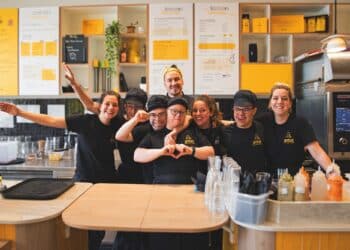
Creating coffee opportunities with Café Joyeux
Co-Founder and CEO Yann Bucaille-Lanzerac reveals how Café Joyeux uses coffee as a vehicle to create opportunities for people with...