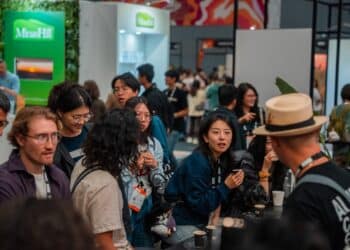
With more than 1600 stores in its home market of South Korea, locations in Canada, Vietnam, and Jordan, and an impending United States debut, theVenti is taking its K-café lifestyle brand to the world.
It could be argued coffee is in the age of the fast-growing, value-driven Asian chain. From the likes of Luckin Coffee in China to Indonesia’s Kopi Kenangan or Thailand’s Café Amazon, a string of franchise brands are rewriting the rulebook governing the consumer coffee world.
South Korea’s theVenti is another big name on that list. With its large-sized, low-cost, K-culture brand proposition, it has surpassed 1600 locations in its home market in barely 10 years at the time of writing. Now, it is primed to take its blueprint to the global stage.
Current Co-CEOs Choi Jun-kyoung and Park Su-am co-founded the business in 2014. The elementary school friends cut their teeth working for a coffee equipment supply company before bringing theVenti to life in front of Busan National University before a nationwide rollout.
Their insight came from a simple observation of the existing Korean coffee market: high prices for small servings. Their answer became theVenti’s core proposition which was proved early by turning around a struggling franchise store.
Why it works
With a population of more than 51 million people in a landmass of just over 97,000 square kilometres, South Korea is densely populated.
It’s a country home to several major, quickly scaling café chains thanks to this demographic, but Choi says the growth of theVenti can be summarised in three main pillars.
“The first is being a clear competitive edge we possess, the second is we offer a capital-light franchise model for our partners, and the third is we have very strong product capability,” says Choi.
“When you are in such a saturated market like coffee, the business proposition becomes even more critical. We built a franchise system with simple recipes and efficient operations that must also be delivery-friendly.
“It’s easy to say from day one we established a very clear value proposition of delicious beverages, generous portion sizes, and reasonable prices.”
While external pressures like rising coffee prices and labour costs have been threatening global supply chains for months, theVenti has remained fiercely committed to its value proposition.
Choi says this is only possible through the brand’s dedication to controlling and simplifying as much as it can in-house.
“Keeping costs low is not about enduring the pressures society puts on us, it’s more about designing and structuring and adapting products to fit the customer’s lifestyle,” he says. “We built a system where cost efficiency naturally accumulates by minimising unnecessary expenses.
“We hold a firm principle that although we offer reasonable prices, we never compromise on our quality. This broadens the customer experience and breaks a stereotype that value-focused brands are boring and lack variety. It’s a stigma we have fought very hard against.
“Our core philosophy is to return the savings created from this structure directly to the consumer in the form of fair prices. That’s why it’s possible to offer these drinks at such a premium quality and a valuable price.”
Underpinning this is theVenti’s investment in ‘Purpleland’ – a R&D lab, coffee farm, roastery, and production line all rolled into one.
This 33,000 sqm facility is located in the province of Chungbuk and produces enough coffee and associated ingredients to make about 315 million cups of coffee per year.
“We produce all our syrups, liquids, and powders at Purpleland. The factory controls all our core ingredients so we can expand our wide menu range across Korea without compromising taste and consistency. It’s a crucial factor in how we operate the business,” says Choi.
“We specifically use BSCA-certified specialty beans in all our stores – not just in Korea. Our signature blend combines beans from Brazil, Colombia and Ethiopia, our dark blend features beans from Brazil, Vietnam, and Colombia, and our decaf option uses Colombian beans.
“From the sourcing stage onwards, we do everything in-house. Since we do everything from A to Z, quality and price can run concurrently.”
Owning the trend cycle
While theVenti’s most popular year-round beverages are its basic coffee offerings, it’s a brand that harnesses trends to create new and limited-edition menu items.
From a recently announced limited edition strawberry line to seasonal menus and monthly product releases, it’s a key component of not only theVenti’s proposition to consumers, but to the rapidly evolving world of coffee.
Choi says trend cycles are shortening, but theVenti continues to identify gaps in the market to keep its customers engaged.
“We begin by analysing market trends and look at customer data to define the flavour and mood the market needs,” he says. “Then, we go through multiple rounds of internal and external evaluation and prototype testing to push the recipes to the highest level possible, because changing the single gram of one ingredient can really alter the entire taste of the beverage.
“Then, we standardise ingredients and the manufacturing process so the drink can be reproduced with the same quality in every franchise nationwide and globally.
“During seasonal periods we offer fruit- or tea-based and collaboration menus, they rapidly rise to be some of our top sellers when they are available. These offer a sense of newness and a firm ‘I must try this’ approach from customers. We want to trigger that psychological factor. It has become a recurring routine where customers will look forward to new seasons and menu launches.”
These non-coffee menus alongside value-driven ‘traditional’ beverages have become the calling card of many booming Asian chains, some of which are looking outside their home markets for expansion.
Choi says although the likes of theVenti, Luckin Coffee, Café Amazon, and Kopi Kenangan share a common denominator, each has succeeded in its domestic market by deeply understanding and meeting consumer needs.
“Low-cost categories can grow when they create beverages that become the easiest everyday choice for consumers. When accessibility is high, prices are reasonable, and the taste remains consistent, it becomes natural that consumers will adopt the brand into their daily routine,” he says.
“Luckin Coffee maximises purchase convenience through their app-based, strategic platform – it’s a very convenient order and pickup system. Café Amazon has embedded itself into daily movement patterns of the consumers, so they’ve put themselves in places like gas stations and community houses.
“Whereas Kopi Kenangan has translated the taste preferences of local consumers really well into their menu and built a grab-and-go system while implementing a delivery-friendly model which allows them to scale urban daily coffee routines at such a remarkable speed.
“Each brand and how they approach their business is different but with one common denominator – the ability to capture the high frequency, everyday consumption. That’s what theVenti aims to do as well.”
Choi sees theVenti’s limited edition and collaboration menu items as his company’s differentiation factor, on top of a reliable everyday menu.
“When it comes to theVenti, it’s reinforcing that same foundation but with our own core values and strengths in terms of large serving sizes, the consensus of taste we offer to our customers, and our agility with trends,” he says. “theVenti has evolved from a brand people drink often to a brand people expect newness from.”
North America and beyond
The announcement of theVenti’s expansion into the western region of the United States (US) – it expects the first store to open in Las Vegas later in 2026 – made headlines in November 2025. But it’s not the first expansion outside its home market.
With locations already in Canada and Vietnam, and a launch in Jordan at the tail end of 2025, it is joining the trend of value-first Asian chains expanding into new markets and turning westward in search of growth opportunities.
Choi explains the four key criteria theVenti considers before entering a new market.
“We define global expansion as not just exporting a store from one country to another – it’s transplanting a K-café lifestyle. When we select a market, we focus less on the size and more on how theVenti can win structurally,” he says.
“We evaluate our common criteria into four different pillars. The first is the frequency of daily beverage consumption in that country, the second being the presence of the Millennial and Gen Z populations that drive trends and visual culture, the third being gaps in demand for affordable, premium offerings.
“The last is a market’s receptiveness to Korean culture, and how we can broaden Asian trends within that local market.”
Those pillars are represented in each of its international markets, from Canada to the Middle East.
“Canada is the first country where we launched an overseas branch. It was chosen as a North American test bed because it has such a strong multicultural and Asian community. We interpreted it as a place that has a high openness to Korean-style trend beverages, and we were right,” Choi continues.
“Vietnam is a traditional coffee powerhouse, but it is also moving very fast. It’s a very fancy and trend-driven market that is rapidly growing with younger generations. This made it an ideal flagship to enter the Southeast Asian market, and our location in Ho Chi Minh serves as the regional international flagship.
“And with the Middle East and the US – where the convenience beverage category is huge– high inflation has created a structural opportunity for these affordable premium concepts.
“We choose markets where we can enter through value and we can drive repeat purchases from customers through the brand experience we can deliver. This framework will continue to guide theVenti’s expansion. We’re taking it one step at a time, but so far, it’s looking good.”
theVenti’s Canada launch started in March 2025 with a location in Vancouver – a city with more than 40 per cent of its population foreign-born, according to Canada’s 2021 census.
The Korean Foreign Ministry of Affairs also ranks Canada as the fourth-most attractive emigration country for Koreans, behind the US, China, and Japan.
This strong multiculturalism and Korean presence played a critical role in theVenti electing to first expand into Canada prior to looking towards the US.
“In Richmond, Vancouver, where we launched, there is a very strong Asian community that is highly receptive to Korean trends and culture. This allowed us to test and anchor the model very naturally within North America,” says Choi.
“For the US, our expansion will begin on the west coast. It’s a region we see as having a very high affinity for K-culture and it’s rapidly growing in terms of affinity for fancy and visual beverages and desserts. The urban logistics structure also enables fast replication.
“The first US store will be based in Las Vegas. It offers exceptionally high foot traffic, it’s a strong global tourism destination, and it’s heaven for entertainment and consumption. This is a market where the demand for affordable, premium drinking experiences is already very well established, which makes it an ideal test bed to imprint and validate our initial format.”
Following Las Vegas, theVenti plans to shift even further westwards into California – namely Los Angeles and San Francisco, areas Choi draws parallels with the market dynamics of Vancouver.
“California is very strong in Asian K-culture, and it’s a place where a lot of Asian nationalities – not just Korean – are present. There’s a fast tendency to adapt to these trends,” he says.
“The North American entry strategy is not about creating a photogenic first moment or a fancy debut, but it’s about designing an expansion formula for theVenti where we can create, learn, and validate our own strategy to replicate and scale out globally.”
Crucial to theVenti’s brand awareness and expansion strategy both in Korea and abroad is its alignment to recognisable figures in Korean culture, the most recent of which is world-famous K-Pop idol, G-Dragon.
Nicknamed the “King of K-Pop”, G-Dragon rose to fame with boy band BigBang before forging his own path away from the group. He is one of the most recognisable faces in Korean celebrity culture.
Much like Nespresso with George Clooney, or Starbucks with Ariana Grande, Choi says theVenti’s alignment with G-Dragon comes from a desire to merge the K-Pop star’s fanbase with the business through organic connection.
“theVenti needed a partner who could expand its visual and business identity onto the global stage. G-Dragon was a uniquely creative and influential artist who represents South Korea on a global level,” says Choi.
“He seemed like a very suitable person to collaborate with, especially because theVenti is still unfamiliar to many overseas consumers. Collaborating with someone whose cultural impact transcends music and allows the brand to be perceived not just as a beverage company, but as a source of lifestyle inspiration.
“It’s a partnership designed to spark cultural relevance from Korea to global expansion and elevate the brand’s presence beyond the product itself.”
The K-culture difference
There is an elephant in the room regarding theVenti’s global expansion, in that it’s not the only Asian brand looking for new market opportunities.
Luckin Coffee has recently opened its flagship locations in Manhattan, New York. Cotti Coffee, at the time of writing, has four locations in California.
Even Chinese milk tea chain Chagee – seen as a potential competitor despite being less coffee-focused – operates in the US.
With the rise of South Korean media in rest of the world through products like Squid Game, Parasite, and K-Pop Demon Hunters, alongside the cultural phenomenon of K-Pop music, the wider world now has a closer affinity to Korean culture.
Choi welcomes the competition of other value-driven Asian chains and sees theVenti’s wielding of Korean culture as an advantage when reaching new consumers.
“We see the US market as the home of convenience, but it’s also the market that adopts new global consumption habits really quickly,” he says.
“[Luckin Coffee and Cotti Coffee] have a very value-driven model that reinforces Asian affordable coffee chains can thrive in the American market. But we do not want to be seen as just another Asian coffee chain. We want to differentiate ourselves and stand out.
“It isn’t about how cheap your drink is, or the price competition. It’s about the distinct K-inspired mood we can provide at the same price point.”
Because, like Choi says, theVenti’s expansion isn’t just the exporting of a store concept from South Korea to somewhere else in the world. It’s the transplant of a model that is known to work, roots and all.
“We combine the cultural appeal of K-trend beverages with a signature large-size experience. It’s a system that’s been proven in Korea since we launched our first store in 2014,” he says.
“Combining the large formats and reasonable pricing with a large beverage range and rapid trend development creates a powerful engine for us to make that affordable, premium, everyday routine in a high frequency market like the US.
“We don’t just deliver the flavour and the drinks, we deliver more, and we believe it’s something our competitors cannot replicate. Our goal is to enter markets on that value and remain through that experience.”
This article was first published in the January/February 2026 edition of Global Coffee Report. Read more here.