The coffee industry is in a period of significant change, with premiumisation, price volatility, and the rise of specialty driving innovation. Unic explores the trends shaping the landscape and their influence on the new technologies it will unveil at Host Milano.
While speciality coffee has become mainstream in places such as the United States (US), the United Kingdom (UK), and Australasia over the past decade, the movement that prioritises high-quality beans has only recently started to gather momentum in previously uninterested markets like Southern Europe.
While countries such as Italy, Greece, and Spain have deeply ingrained coffee cultures, until recently they were largely indifferent to specialty. However, according to Unic General Manager Tommaso Fontana Rava, this tide is starting to turn.
“The US, UK, and Australasia were early adopters of specialty coffee and it’s become massive in these countries. Other markets such as Asia followed and, because they didn’t already have much of an established culture of coffee, there was little reluctance to embrace this new style,” he says.
“Southern European markets have been much slower to adopt specialty because they have traditional roasting styles and ways of drinking coffee. Specialty couldn’t seem to get a foot in the door, but that now appears to be changing.”
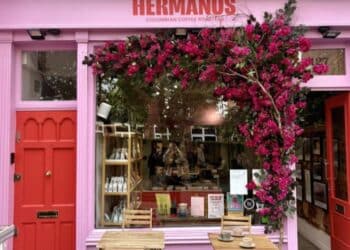
Fontana Rava highlights Spain and France as two markets that have seen “an explosion” of specialty venues, with large cities such as Paris and Madrid leaning into the trend. He believes it’s younger consumers, who often desire newness and prioritise quality, that are fuelling the expansion.
“Today, young people crave a different kind of experience when they go into a coffee shop. They want to know where their coffee comes from, what happens to the bean, and for it to be presented with latte art,” he says.
“This is not to say the historic method of roasting and enjoying coffee is dead – traditional roasters are still thriving – but it cannot be ignored that there’s a new style of coffee and coffee shops popping up across the region.”
The price of a cup of coffee in these regions could also be influencing the shift to specialty. Fontana Rava says the high green-bean prices experienced in the second half of 2024 and first half of 2025 have driven major market change.
“The volatility sent shock waves through the industry – both high and low,” he says.
“High prices have much less of an impact on the specialty sector because most specialty roasters already charge more for their beans and don’t rely on the commodity market (C-market), whereas roasters that buy lower-grade coffee are much more price sensitive. Over the past year, this made the price of an entry-level cup of coffee go up, resulting in a smaller difference between the cost of a standard and a specialty cup – making specialty a more enticing prospect for some consumers.”
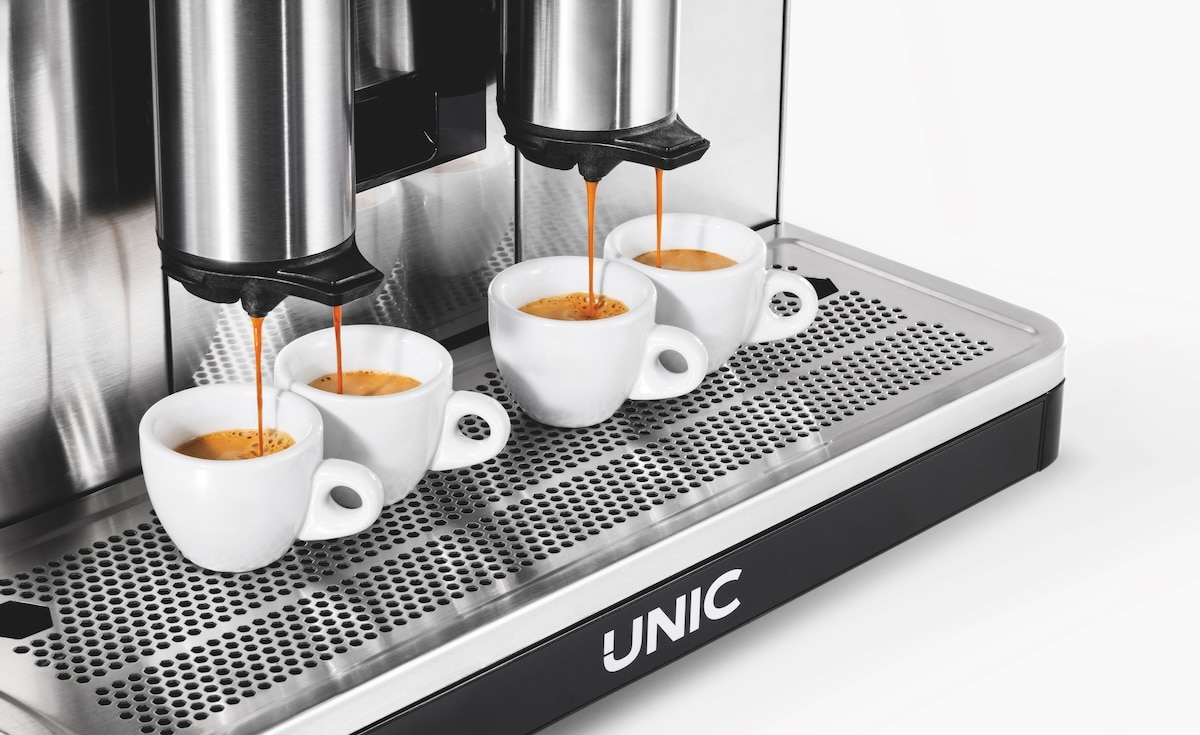
Both the increasing interest in specialty and higher prices among traditional brands are influencing wider change in the coffee industry. Fontana Rava and the team at Unic believe these trends are resulting in a polarisation of the market and, in terms of equipment, roasters and venues are looking for either entry-level machines or high-end models.
As one of the few manufacturers on the market developing both traditional and super-automatic espresso machines, Unic is in a unique position to respond to this split in the market. As such, at Host Milano in October the brand will be introducing a series of new advancements for both ends of the sector.
A new take on traditional In response to rising costs faced by roasters and cafés, Unic is launching a new range of traditional espresso machines designed to deliver exceptional performance and refined design without compromising on value. The new platform draws from Unic’s renowned engineering, bringing forward key features from its existing machines while placing a heightened emphasis on aesthetic integration.
“We’re committed to helping roasters and café owners manage their investments wisely – without sacrificing the experience they deliver to their customers,” says Fontana Rava.
“This new machine is built to blend seamlessly into both high-volume environments and design-focused specialty coffee spaces. It’s built with purpose, and it looks the part.”
Another key goal in development was to ensure the new model performs reliably in busy service settings, maintaining pace and precision. The Compact solution While the new traditional machine platform will cater to conventional coffee brands, updates to Unic’s automatic offering are geared towards the rising specialty market. At Host, the team will unveil the latest edition to the TANGO XP line.
“As specialty coffee becomes mainstream, the needs of the market are changing. Venues that serve specialty coffee are scaling up and some can’t afford to have each coffee crafted from scratch by a barista on a traditional machine,” says Fontana Rava.
“Therefore, there’s an increasing need for fully automatic espresso machines that can deliver the quality and standard expected of specialty. Our ultimate goal is to produce a machine that performs in a way that the users wouldn’t be able to tell the coffee has been crafted on an automatic in place of a high-end traditional.”
The new TANGO XP Compact model is designed to meet the demands of high-quality coffee preparation through improved grinding precision and calibration capabilities.
“With a smaller footprint than the other machines in the TANGO XP range, Compact is designed to increase flexibility and keep quality consistent while delivering a high output,” he says.
The machine will also feature a suite of new technologies, including automatic grind-size calibration.
“Coffee is a natural ingredient that changes due to many factors, so we know calibrating the machine can be a time-consuming task for our customers. We have introduced integrated weighing equipment that can perform calibration at just the touch of a button,” says Fontana Rava.
“We have added motorised grind settings too, so users can change the setting using a button instead of having to manually adjust the grinder.”
Unic’s team of engineers have also added a gear pump to the Compact model. Typically used in traditional machines, the pump gives the user the flexibility to dial in their shot at the preferred pressure profile to create the desired extraction curve.
Enhancing energy efficiency UNIC is also conscious of environmental issues and is actively looking for solutions. Recent efforts have focused on developing a new instant heating system and boilerless technology, working alongside an innovation partner.
These features aim to significantly lower power usage while maintaining top-tier performance.
“We know sustainability and energy consumption are very important to our customers when considering new machines,” says Fontana Rava.
“We’re looking into new technologies that remove the need to keep water constantly hot inside the machine. It only uses the energy to heat up the water when it’s needed, rather than consuming energy to keep it warm.”
Alongside a reduction in energy consumption, he highlights that it also reduces the impact of scaling inside the boiler.
“Scale is one of the biggest issues in coffee boilers because it creates a lot of problems, such as clogging the machines. Removing the issue of scale will improve both the quality of the water and the durability of the equipment,” he says.
“Typically, water sits inside the boiler at 90 degrees Celsius for a long time. Having water stagnant at that temperature changes the molecular structure, which then impacts taste.”
Unic will be showcasing its new technologies at Booth C12-D11 in Hall 12 at Host Milano from 17 to 21 October.
For more information, visit unic-espresso.com
This article was first published in the September/October 2025 edition of Global Coffee Report. Read more HERE.